
| teahupoo | mavericks | cortes banks | shipstern bluff | ghost trees | jaws | n.w. ireland | dungeons | waimea bay | improve your surfing |
SURFING JAWS. PEAHI, MAUI NORTH SHORE HAWAII
The North Shore of Maui is one of the best big wave spots in the world. The towns Paia, Haiku, Kuau or Spreckelsville, have good access to the this big wave surfing mecca with surfing, windsurfing, kitesurfing and towsurfing all there in there backyards.
Jaws is offPeahi Bluff . The paddle is about 20minutes if you are nuts. Jaws doesn't start breaking until its 4meters. It was first tackled by the sailboarders in the early years, but just before the start of the of the new millenium in the winter of 98 came the emergence of the Laird Hamilton attack armed with mates and jetskis.
The township of Haiku lies at the edge of the rainforest. Its old pineapple canneries have been converted into housing, shops, restaurants and studios. Haiku is full of character and has a charm about it that attracts a lot of visitors not just for the big waves breaking at Peahi. To get there follow the Hana Hwy from Kahului Airport eastwards along the North Shore for about 20 minutes. Stop in Paia and ask whilst buying a snack from this once old plantation town.


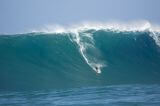

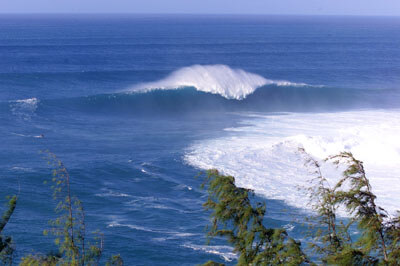
Jaws or Peahi breaks over perfectly shaped triangle reef. The winter swells that pound the Hawaiian shores come all the way from the Aleutian island chain in the far north of the Bering sea. Unimpeded by landfall they arrive at Hawaii full of raw power.
Peahi doesn't break all that often and may only get big a couple of times a year and huge once in a few years, but when its on its awe inspiring, and with an ever increasing number of hellmen charging and pwc's finding grief on the rocks below Peahi Bluff, the gasps of photographers and spectators on water, on land and in the air are just as deafening as the roar of the huge waves of Jaws.
Jaws is surfed in the northern hemispheres' winter. Big swells can arrive on the Hawaiin island chain from October through to April. The climate here is agreeable due to the coolness of the consistent trade winds that blow bringing with them those misty rainbow mornings across a scenery of green landscapes of pineaple and sugar cane farms at the base of Haleakala.
SURFING JAWS. |
||
Day one, 8 a.m. Day two, 8 p.m. |
Day three, 8 a.m. As swells roll by, buoy 51001 measures wave height and period- the length of time between crests. The longer the period, the faster the wave. Using the buoy data, scientists and surfers can calculate how quickly the waves might reach Jaws, and how big they'll be when they do. |
|
Local surfers call Jaws by its native name, Peahi, Hawaiian for "beckon". And that's just what it does. "You can hear it from miles away, " says Laird Hamilton of the spot's siren song- the thunder of giant waves pummeling a normally placid shoreline.
Jaws generates a breaking wave only when ocean swells reach a certain size. From the north shore of Maui a massive underwater ridge- the remnant of an old lava flow- juts straight out to sea. "It's impressive in its size and its steepness. It's huge," says former champion surfer Rick Grigg, now a professor of oceanography at the University of Hawaii.
A little over half a mile from shore the reef drops abruptly away into the sea. An average swell of 10 to 12 feet passes over the nub of the reef without incident. But larger swells, storm spawned, suddenly mound upward as they strike the reef, a process called shoaling.
Jaws has a second wave-rearing trick. The swells on either side of the reef, moving in deeper water, bend inward, focusing much of their energy on the center of the wave crest. This refraction of wave energy is like a magnifying glass gathering light into a hot, focused beam. In essence, the reef squeezes the wave inward and upward. Surfers call it a peaking wave. It's a pyramid of water worthy of a pharaoh.
The deepwater channel next to the underwater ridge also ensures that there is a safe zone Where the wave won't break. That's where surfers are headed when they're flying down the face of Jaws
As a wave hits Jaws' steep reef, it moves from deep ocean to shallow water in less than a minute. This depth change can cut the speed of a 50-mile-per-hour wave in half. It also compresses the wave, causing it to rear up to maximum heigth as it wraps around the reef.
Tow-In surfboard designs differ from your stock surfboard . They are shaped narrow and thin with out too much rocker and usually have a flat bottom . Tail shape varies but swallow tails are the most common. Length of the tow-in boards are usually around 6 feet. An example of a tow-in surfboard meausurments would be 6'2" x 16 1/2 x 1 1/2. They're strongly glassed and the boards usually weigh anywhere from 7-20 pounds. The heavier glass jobs are for the windy, bumpy conditions, the lighter for glassy waves

Money,PWC, life vest, rashies, spare leggies- good and thick,
sunscreen, powder for reef cuts , spare undies and a
mate to take your photo.
coral cuts, Lip launches, Tiger sharks, pwc's accidents,broken bones,running out of money
The launching area for the jetskis or personal watercrafts (pwc's) as we now call them is usually Maliki Gulch or Kahalui Harbor. Spectators line the cliffs on top of Peahi Bluff, but be warned it can get crowded with a fair bit of jostling for the best positions, making the danger of falling a real one.
Places to stay Budget hostels expect to pay from $50-$100usd per night. Or $140 per night will get you a 1 bedroom studio, minimum 5night stay at Poli Makai estate.http://www.polimakai.com